
Selection guide · 3 min read
Stainless Steel Profiles and Their Architectural Applications
Explore six stainless steel profile families for edges, corners, stairs, decorative lines and glass/shower details, with a clear specification checklist.
Stainless steel profiles serve several different architectural details. Selecting the material does not finish the specification: the section must still suit the junction, fixing and exposure. A decorative strip, a glass channel and a stair nosing should be evaluated as distinct products.
The FIRST METAL stainless collection contains six image-backed families. These identify product types and applications; they do not establish a complete dimensional or grade schedule for every ordered section.
Choose the relevant family
The range separates Glass & Shower Profiles, Listello Profiles, Round Edge Profiles, Stair Nosing Profiles, Straight Edge Profiles and Corner Protection Profiles. Start with the job the section must perform. A listello creates a decorative line; an edge trim addresses the boundary of a covering; a corner protection profile covers a junction. The same visual finish can occur on different shapes. Keep the product-family reference attached to every enquiry so a general request for inox trim does not conceal the intended application.
Review wet-area and glass details carefully
For a glass or shower application, provide the glass or panel specification, substrate and proposed fixing arrangement. The presence of a channel in a photograph does not prove a particular glass-thickness range, load capacity or waterproof assembly. A decorative profile also does not replace the designed waterproofing detail. Ask for the complete interface and any associated seals or fixings to be confirmed. Keep responsibility for glass support and the surrounding construction clear before ordering.
Confirm material suitability
Identify cleaning chemicals, moisture and expected mechanical contact. Schlüter's stainless-profile guidance emphasizes checking suitability against the anticipated stresses and distinguishes its own material variants. Those grade designations belong to that manufacturer's product. They should not be copied onto an FIRST METAL record without supporting documentation. If the project requires a particular grade or test evidence, include that requirement in the specification enquiry and obtain confirmation for the supplied section.
Technical reference: Schlüter-Systems: SCHIENE-E material and installation information
Keep stair performance separate from appearance
A stair nosing must be reviewed as part of the stair assembly. Describe the substrate, covering thickness, fixing approach and operating environment. A ribbed or shaped surface in an image is not proof of a slip-resistance classification or other performance certification. Ask for the relevant evidence where the project requires it. Compare the full section, the leading-edge detail and any terminal parts, then coordinate the installation with the responsible project team.
Plan handling and maintenance
Check the supplied finish and protect visible faces during cutting and installation using the selected product's instructions. Agree a cleaning method appropriate to the finish and site contaminants. DURAL's care guidance is an example of why chemical suitability and non-damaging cleaning need to be considered together; it is not a universal cleaning-product approval. Give the maintenance team the final product and finish references so later cleaning does not rely on a generic description of stainless steel.
- Family, drawing and required dimensions.
- Material/grade requirement and supporting evidence requested.
- Environment, substrate and proposed fixing or glass interface.
- Finish sample, accessories, quantities and care information.
Technical reference: DURAL: DURAPLUS technical information
Choose the stainless steel grade for your project
FIRST METAL offers AISI 201 and AISI 304 options. Select the grade separately from the surface finish. Confirm the supplied grade, section and finish in the quotation and supply documentation.
| Material selection | AISI 201 | AISI 304 |
|---|---|---|
| Material family | Austenitic chromium-manganese-nickel stainless steel | Austenitic chromium-nickel stainless steel |
| Indicative composition by mass | Cr 16–18% · Ni 3.5–5.5% · Mn 5.5–7.5% | Cr 18–20% · Ni 8–10.5% · Mn ≤2% |
| Project positioning | An economical stainless option for suitable interior and decorative applications, following exposure and maintenance assessment. | A widely specified general architectural stainless steel for interior details and other environments assessed for the project. |
| Selection considerations | Lower nickel and higher manganese than 304. Confirm the specified grade rather than treating all low-nickel stainless steels as equivalent. | Established general-purpose corrosion resistance does not make 304 rustproof or universally suitable for marine, chloride-rich or aggressive chemical exposure. |
Composition ranges are indicative grade information, not a certificate for supplied material. Limits depend on the applicable product standard; confirm the order specification and material documentation.
For either grade, assess moisture, chlorides, cleaning chemicals, crevices and maintenance access. Surface finish and fabrication affect performance; appearance alone cannot identify the alloy or establish corrosion resistance.
Specify the required brushed, polished or other surface separately and approve a sample. Remove deposits with an appropriate mild cleaner, rinse and dry; avoid chloride-containing cleaners and carbon-steel contamination. Agree a maintenance schedule suited to exposure.
Discuss your material selectionTechnical references and scope
Frequently asked questions
Can a stainless shower profile establish waterproofing?
No. The profile must be coordinated with the designed waterproofing and fixing assembly. The family photograph does not certify that complete system.
Do stair-profile images establish slip resistance?
No. A surface appearance is not a test classification. Request the evidence required by the project for the selected product and assembly.
Discuss your project detail
Send the profile reference, application, drawings and quantity requirements. Include the points from this guide that need confirmation for your project.
Technical references and scope
Product-specific information comes from the linked FIRST METAL catalogue records. External manufacturer examples explain principles; their dimensions, ratings and compatibility are not transferred to FIRST METAL products.
- Schlüter-Systems: SCHIENE-E material and installation information
Example of material suitability review and embedded anchoring-leg installation. Competitor grades and joint widths are not FIRST METAL specifications.
- DURAL: DURAPLUS technical information
Material suitability under chemical/mechanical exposure and care principles; no grades or certifications transferred.
Products for this detail
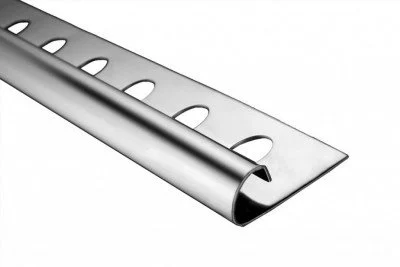
Stainless Steel Round Edge Profiles
A curved visible head with a perforated anchoring flange for rounded tile-edge detailing. The stainless steel reference shows the relationship between the exposed curved face and the leg beneath the tile build-up.
Enquire about this product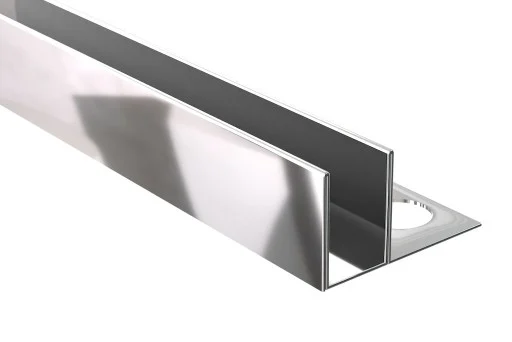
Stainless Steel Glass & Shower Profiles
An open channel with upright sides and a perforated fixing flange, supplied for glass and shower-profile enquiries. The channel receives the glass edge; this geometry is distinct from a rounded tile trim.
Enquire about this product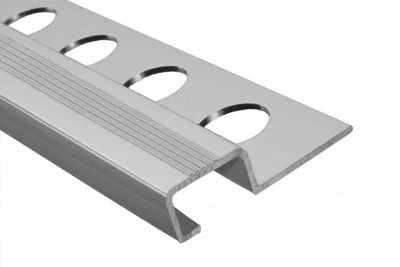
Stainless Steel Stair Nosing Profiles
A ribbed tread-edge face, downturned front and perforated anchoring flange distinguish this stainless steel stair-nosing family. Use the section reference to discuss the transition between the stair tread and riser.
Enquire about this product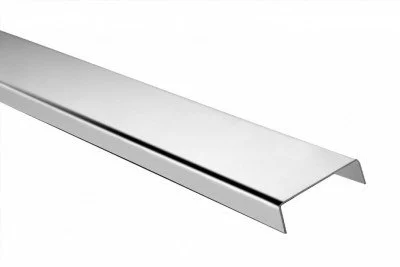
Stainless Steel Listello Profiles
An open-backed border section with a flat visible face and downturned sides. Stainless steel listello profiles introduce a defined metallic line between tiled surfaces or within a feature-wall composition.
Enquire about this productContinue reading
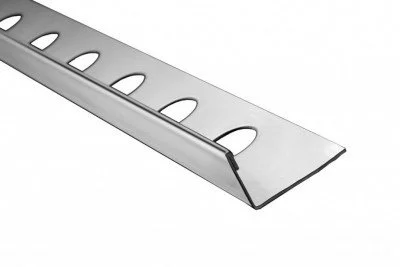
Comparison · 3 min read
Aluminium vs Stainless Steel Profiles
Compare aluminium and stainless steel architectural profiles through application, exposure, finish and specification requirements rather than appearance alone.
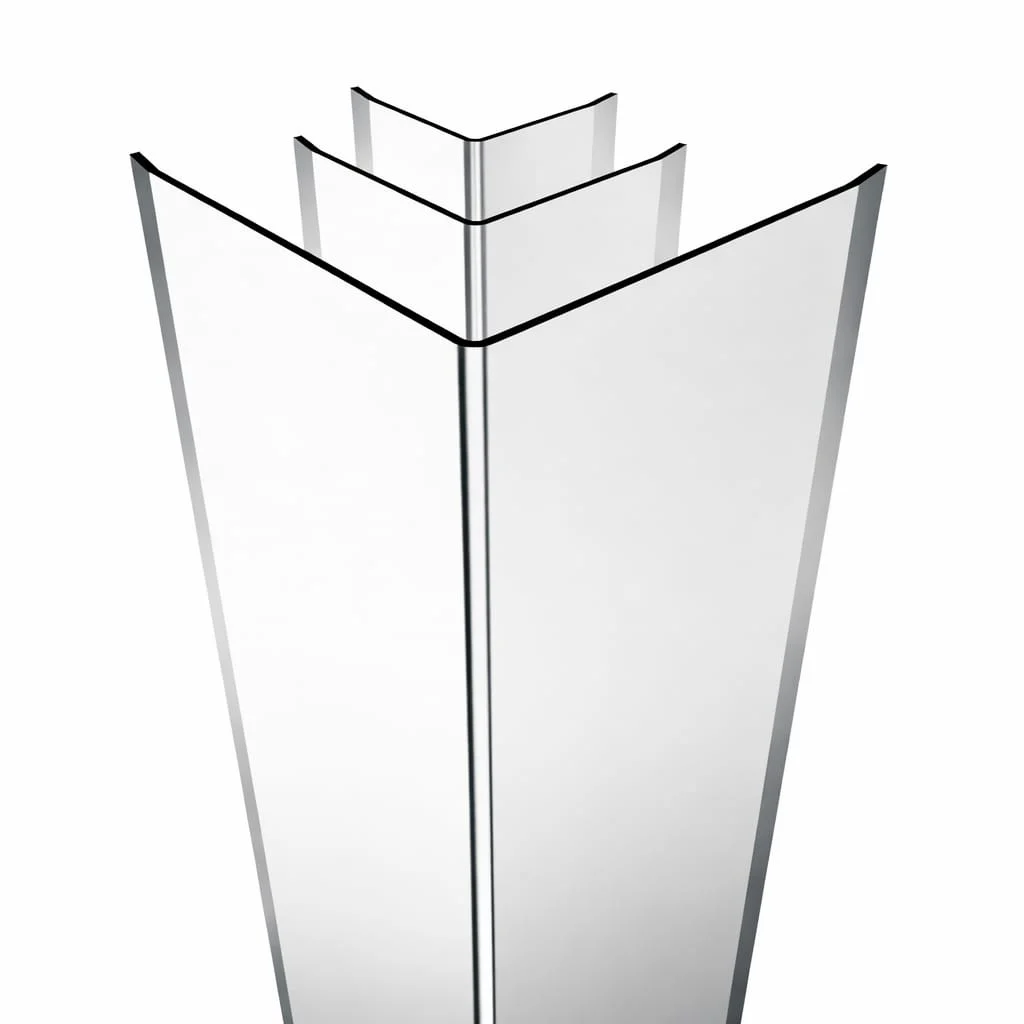
Selection guide · 3 min read
Choosing Profiles for Wall Corners and Edge Protection
Distinguish plain L corner covers, anchored tile trims and stainless corner protection. Check coverage, fixing and the finished corner before ordering.
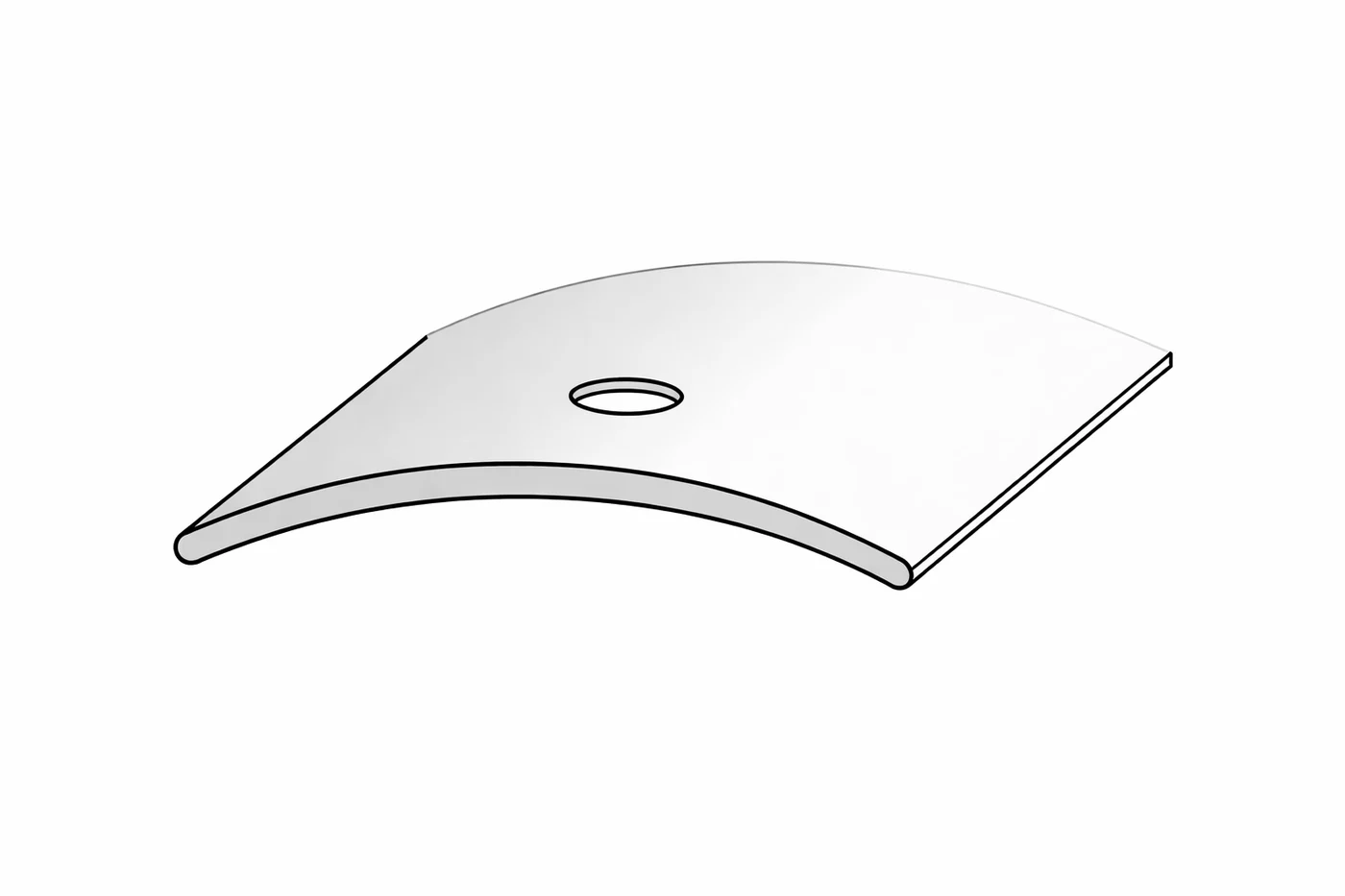
Installation planning · 3 min read
Planning Profiles for Floors, Stairs and Balcony Edges
Prepare floor-transition, stair-nosing and balcony-edge enquiries using the actual build-up, exposure and junction detail, without assuming performance ratings.